
When a bomb cyclone tore through the Pacific Northwest, King County Library System had to close its doors, but its network never went dark. People kept connecting to library Wi-Fi from outside the buildings, and E-rate helped make sure that network was there when the community needed it most.
BJ Colvin, Director of IT Services at King County Library System, has worked with E-rate for more than 15 years, first in K-12 and now in libraries. He is clear that the program is not just a way to get cheaper internet. “When you go back to the 1996 act, it’s about expanding access,” he said. “Libraries play a key role in that.”
His story is worth hearing for any applicant or service provider trying to explain what E-rate actually makes possible. The timing matters too, because the FCC is taking public comments on the future of the program right now.
The day the lights went out
The storm left BJ without power for seven days and without cell service at his own home. At the library system’s service center, a generator kept the network running for all 50 libraries.
On the day of the storm, every library was physically closed because roads were impassable. The network traffic tells the rest of the story. People still showed up outside the buildings to get online. When the system reopened, only half its libraries could open, and students and people who still had to work came through the doors right away.
“Emergency resilience is probably the one thing no one is expecting until it’s needed,” BJ said.
Built for the whole county, not just the busiest branch
King County Library System serves all of King County outside Seattle and is one of the largest library systems in the country. It recently upgraded every one of its 50 libraries from 100 megabit to 1 gig service.
Its most rural library is in Skykomish, a small town about two hours from the service center. Skykomish averages 24 power outages a year. The library system equips that branch with extra resilience and outdoor access points, even though it costs more per site than larger libraries.
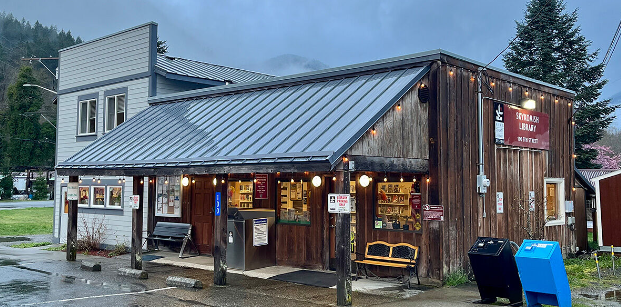
Those outdoor access points matter. Some people need to fill out government forms but do not feel comfortable coming inside a library. They can sit in the parking lot and connect instead, and BJ says the library’s data shows the service is heavily used.
What the E-rate dollars actually do
The library system’s network costs run close to $1 million a year, and E-rate covers 80% of that. BJ estimates E-rate accounts for just under 10% of an IT budget of about $11 million.
That share is hard to replace. Washington state law limits how much the library’s tax revenue can grow each year (1%) without going to voters. The savings also reach beyond the internet bill itself. “It’s not a direct one to one,” BJ explained. E-rate savings free up money for other needs like redundancy, backup power, and a secure network.
Looking to the future of E-rate
The storm showed what E-rate helps King County Library System sustain today. Looking ahead, BJ is equally focused on what the library could lose without that support and on the growing needs the program does not currently cover. He has already mapped out the first cuts: resilience would go first, starting with the backup power and redundancy that kept the network alive during the storm.
Public computers would be next. The library system offers about 1,200 free public computers, and 600 to 700 of them are in use at any given moment. Many users are elderly or unhoused, have disabilities, or are completing government forms. Today those computers are replaced every four years. Without E-rate to offset the technology budget, that cycle would stretch to six years, and patrons would be working on slower, older machines.
Cybersecurity is one of the clearest examples of the growing needs the library is facing. When BJ became IT director in 2022, the library spent about $100,000 a year on network security. In the 2027 budget, that number is about $1.4 million.
Part of the reason is the library’s openness. Anyone can walk in and connect, so the edge of the network takes constant hits. BJ says the firewall used to block about 300,000 attempts a week. It now blocks more than 4 million a week. That is why he wants to see E-rate expand to cover cybersecurity. “There’s no revenue to offset it,” he said, “and it’s required for our network to operate at all.”
Beyond funding eligibility, BJ is also watching possible changes to filtering requirements. Libraries comply with the Children’s Internet Protection Act (CIPA), but they also have obligations including providing unfiltered access to adults who request it. If federal rules and state law ever conflicted, a library could be forced to choose between them. For King County, that could mean giving up E-rate funding.
His second concern is paperwork. The library system has no dedicated E-rate staff. Its network engineer and infrastructure manager handle E-rate tasks on top of keeping the network running, and they must keep documentation for 10 years through staff turnover. His other wish is simple: a modernized application portal.
What other applicants and service providers can take from this
- Capture your network’s worst day. BJ’s has persuasive evidence with traffic data. If your network carries your community through an outage, closure, or emergency, save that data. It tells your story to your board, your community, and the FCC better than any budget line.
- Plan for the documentation burden now. Ten years of records will outlast most staff. Build a system that doesn’t live in one person’s inbox.
Facing your first E-rate cycle, or juggling a Category One and Category Two project like BJ? You don’t have to navigate it alone. Request a consultation to talk with a Funds For Learning Guide.
About the Author: Michelle Jackson is an E-rate Guide at Funds For Learning. She lives in the Oklahoma City metro with her husband, two kids, and three cats, and gardens when she is not planning successful Category Two summer projects.