
Twenty-one organizations, Funds For Learning among them, filed initial comments by September 30 in the FCC’s review of how USAC runs the Universal Service Fund (WC Docket No. 26-173, FCC 26-52). They come from every corner of the fund, and on the two proposals that worry applicants most, they line up. Not one commenter supported pay-and-dispute, and not one endorsed extrapolated recoveries as the FCC proposed them.
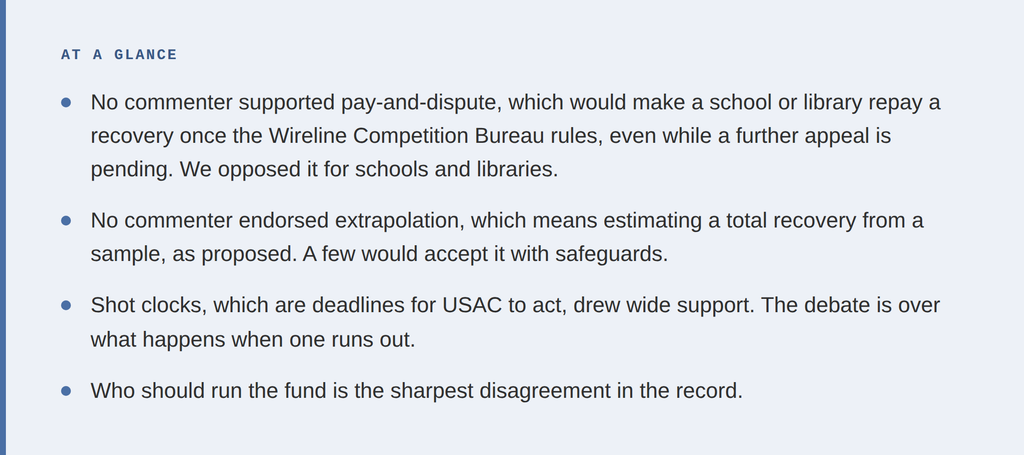
The Notice of Proposed Rulemaking asked whether USAC should remain the administrator, whether participants should repay disputed funds while appeals are pending, whether audit findings from a small sample should be extrapolated across a participant’s funding, and how USAC’s Board should be structured. State E-rate coordinators, library and anchor institution coalitions, rural hospitals, small rural telephone companies, Lifeline providers, the national wireless association, and constitutional litigators all answered. Commenters this different rarely agree on much, yet on pay-and-dispute and extrapolation they reached the same conclusion from opposite ends of the fund.
The record’s through line matches what applicants told us in our 2026 survey, published in the 2026 E-rate Trends Report and cited throughout our comments. In that survey, 82.8 percent of respondents are satisfied with USAC, and 90.8 percent say they can depend on E-rate funding every year, the highest mark in the eleven years we’ve asked. Only 60.5 percent agree that program processes are fast, simple, and efficient. The program works, and the processes around it are what need fixing. Nearly every filing in the docket, whatever its author’s vantage point, is aimed at that gap.
Commenters brought evidence from their own files
Rural carriers supplied the record’s most vivid audit evidence. WTA described two-day response deadlines that arrive at 4 p.m. on a Friday, a company that spent $150,000 responding to an audit of $350,000 in support, documentation demanded for plant placed in service in 1995, and an audit finding over $34 worth of flowering plants. NTCA described different outcomes on identical issues depending only on which auditor drew the file. It calls that “audit roulette.”
Applicants brought numbers too. The Michigan Statewide Educational Network (MiSEN) documented that its final funding commitments arrived after the September 1 target in nine of the last ten funding years, including $14.2 million committed 53 days after the funding year had already ended. CHA Broadband Services, a Colorado rural health consortium, showed that network management, equipment, and installation make up about 21 percent of requested Rural Health Care dollars but have drawn 56 to 58 percent of all denied dollars since FY2024, under eligibility criteria that appear in no published rule.
Where the commenters landed
|
Commenter |
Position |
Notable point |
|
Ad Hoc Broadband for Rural Health Group (6 orgs, 5,000+ health care sites) |
Pay-and-dispute unnecessary; fix the appeals backlog instead |
Members have appeals pending five-plus years; FCC rules already require decisions in 90 days |
|
Bring administration in-house; cap administrative costs at or below 3.06% of disbursements |
The only commenter supporting the consultant Board exclusion |
|
|
No denial on any unpublished criterion |
Its network management commitment rate was 1.4%, against 60% for all other applicants |
|
|
Current rules do not authorize extrapolation |
USAC extrapolated 6 sample failures into a 10.53% failure rate without applying a margin of error |
|
|
Remove USAC; transfer administration to the FCC |
Attaches its pending Fifth Circuit briefs; the same arguments are in live litigation |
|
|
Reject pay-and-dispute; oppose budget caps |
An audit missing its final report deadline should be deemed abandoned with prejudice |
|
|
Keep USAC; make it faster and fairer |
$1.67 billion, 46% of FY2026 requested dollars, was still pending on September 2 |
|
|
Retain USAC; caution on rigid shot clocks |
Feed appeal reversals back into reviewer training rather than racing the clock |
|
|
Make the September 1 commitment target binding |
FY2020 applications were funded up to 821 days after the filing window |
|
|
Delete the appeal-to-USAC step entirely |
USAC “almost never disagrees with itself”; appeals should go straight to the Bureau, decided in 90 days or deemed granted |
|
|
Calibrate audit exemptions to Tribal scale |
Under the FCC’s own parameters, a 500-record district must sample 43.5% of its records; a 100,000-record district samples 0.38% |
|
|
Exempt support of $50,000 or less per program per year from random audits |
A $21,000 Lifeline reimbursement cost one member more than $29,000 to audit |
|
|
Materiality thresholds; auditees may elect full review over sampling |
$500 in billable audit hours to resolve a $30 misallocation |
|
|
Oppose codifying extrapolation; $250,000 de minimis exemption |
Adopts our argument that heterogeneous funding requests make extrapolation unreliable |
|
|
Keep a separate administrator; no consultant Board bar |
The FCC has not yet defined who counts as a consultant |
|
|
AI may assist, but a human must sign every funding determination |
An AI encoding rule interpretations at scale would be policymaking USAC is barred from |
|
|
SHLB Coalition / ALA (320+ anchor institutions; 123,000 libraries) |
Keep the external administrator; no pay-and-dispute |
USAC kept processing during the Fall 2025 government shutdown; the Bureau reversed its own decisions 50+ times in five years |
|
Keep USAC; keep school and library Board seats |
Report the days an application sits awaiting FCC guidance |
|
|
Limit recovery lookbacks to five years |
USAC sometimes claws back beyond even the ten-year document retention period |
|
|
Enforceable 90- and 120-day shot clocks |
USAC may not impose new documentation requirements mid-review |
|
|
No random audit of a small company more than once every six years |
Describes the current audit process as “Kafkaesque” |
SECA supplemented the record with a September 25 ex parte reporting that documentation accepted in prior years is suddenly being rejected in FY2026, with applicants learning of the change only through PIA inquiries. The docket also includes a July ex parte from WISPA and two brief individual comments.
Two requests run through many of the filings. Commenters want USAC to publish its appeal decisions and cite the rule behind each one, and six of them proposed an ombudsman who can help when a filing goes quiet. SECA also asked that PIA reviewers check in with applicants every 30 days and that appeals be viewable in EPC.
The record splits over who runs the fund
To be fair to USAC, most commenters who took up its future want to keep it. SECA, SHLB and ALA, the Kentucky and South Dakota departments of education, and we all asked the FCC to keep USAC as administrator. SHLB and ALA pointed out that USAC kept processing during the Fall 2025 government shutdown while appeals that depended on the FCC stalled.
Others want a different structure. The Center for American Rights wants the FCC to bring USF administration in-house in phases. Consumers’ Research argues that USAC’s role is unlawful and should end. NaLA would rebid the administrator’s role every five years.
The USAC Board drew its own debate. Most E-rate commenters want to keep the school and library seats and the programmatic committees. CTIA, WISPA, and the Center for American Rights favor a smaller Board, and CTIA and WISPA want more administrative expertise on it.
One proposal aims directly at firms like ours. The Center for American Rights asked the Commission to bar paid USF consultants from serving on the Board, the only commenter to do so. As a firm that helps applicants with their filings, we have a stake in that question. In our comments, we opposed an exclusion by occupation and supported a single codified conflict-of-interest standard, with annual public disclosure, applied to every Board member. SECA and the South Dakota Department of Education also opposed the exclusion, and SECA made the same point we did: the Commission hasn’t yet defined who counts as a consultant.
Three principles the record supports
Published standards. Across four programs, commenters described funding denied on criteria no applicant could have found in advance: unpublished annual review procedures, documentation requirements changed mid-review, and interpretations that shift without notice. Their remedies converge. Publish the standards before the filing window opens, apply changes prospectively, and when USAC is waiting on FCC guidance, say so and report that time separately. Our comments added that anything the administrator tells one participant should be available to every participant.
Proportionality. Every commenter that took up a small-dollar audit exemption supported one, whether as a dollar threshold, a frequency limit, or a materiality test. They differ only on the number, which ranges from $10,000 per funding request to $250,000 per program each year. The record’s examples, a $34 finding, a $30 misallocation, and a near-complete audit of a small Tribal district, all make the commenters’ case that oversight should cost less than what it protects.
Consequences on the process, not the applicant. Commenters split between binding shot clocks and softer benchmarks, and Kentucky cautioned that rigid clocks could trade accuracy for speed. Where commenters proposed a consequence for a missed deadline, it lands on the process: automatic transfer of overdue appeals to the Bureau, canceled audits with auditor fees clawed back, or decisions deemed granted. We made the same point in our comments. An expired clock should never count against the applicant.
Proposals that would simplify E-rate work
Some proposals would lighten the paperwork. SECA, South Dakota, and MiSEN want discounts validated once every five years. SHLB and ALA proposed competitive bidding exemptions for small-dollar requests and asked the FCC to apply the federal five-year statute of limitations to recoveries. TechFreedom, from the other end of the policy spectrum, also wants recovery lookbacks reined in.
What comes next
The record is still being written. Reply comments are due October 30, 2026, and you can file one through the FCC’s Electronic Comment Filing System by entering WC Docket No. 26-173. If your school or library has waited months for a commitment, had an appeal sit undecided, or been denied on a standard you never saw published, that experience belongs in the record. A short reply comment describing it helps the FCC see the problem at its real size.
You can also read our full comments, including the data and citations.