
On October 12, Funds For Learning filed comments in the FCC’s review of the E-rate program, WC Docket No. 26-133. The Commission is asking bigger questions than usual this time, starting with whether E-rate has finished its job, and most of our answers lean on what applicants told us in our 2026 survey, published in the 2026 E-rate Trends Report. Reply comments are due November 12.
E-rate still has work to do
The NPRM cites data suggesting that virtually all schools now have broadband and Wi-Fi, and it asks whether that means the program’s mission is accomplished. We don’t think it does. Those connections are there because E-rate helps pay for them, month after month. Internet access and WAN service are recurring bills, and if the discount shrank or went away, the cost would move to local budgets. The poorest and most rural communities would feel it most, because their discounts are the highest.
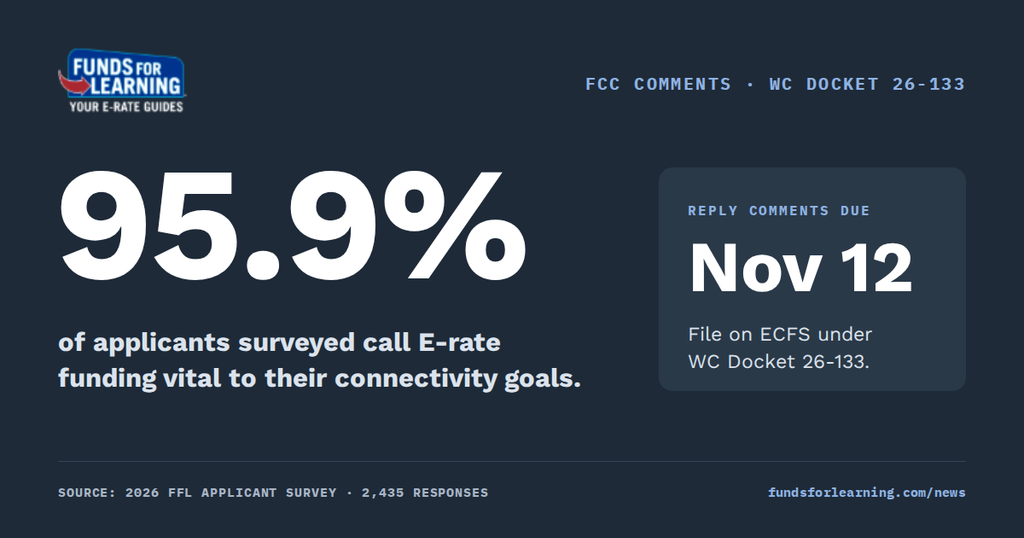
In our 2026 survey, 95.9 percent of respondents called E-rate funding vital to their connectivity goals, and 90.8 percent said their organization can depend on it every year. A Tennessee district wrote that without E-rate, “we would not be able to afford even the basic internet access required for State testing in our district.”
The NPRM also asks why requests have stayed below the funding cap. Much of the answer is that schools and libraries pay their own share of every bill, which came to $1.06 billion in FY2026 requests, and they spend that money carefully. Competitive bidding keeps prices down as well. In the survey, 78.6 percent said bidding lowers the prices they pay, the highest share we’ve recorded on that question.
Our comments also defend BEAR. One theory discussed in the NPRM would route all support through telecommunications carriers, which would end direct reimbursement to applicants. As of September 30, 2026, applicants had picked BEAR on 26.9 percent of FY2026 funding requests.
Screen time decisions belong to school boards and parents
E-rate pays for the connection to a school or library and the network inside the building. It has never paid for devices, apps, or content, and much of the NPRM’s concern about screens involves things the program doesn’t buy. We told the Commission it has no authority beyond CIPA to regulate screen time, and we asked it not to tie E-rate funding to screen time limits.
States and districts are already writing these rules. As of July 2026, at least 39 states and the District of Columbia had laws or policies on student cellphone and device use. In June, the Los Angeles Unified board adopted some of the strictest classroom screen time limits in the country. Under a federal funding condition, a school that fell short would lose internet access for every student in the building.
On CIPA, we asked the FCC to keep the statute as Congress wrote it. When a school misses a step in the public notice or hearing process, it should be able to fix the problem by giving the notice and holding the hearing, without having years of funding clawed back.
The consultant proposals
We help applicants with their filings, so we have a stake in this part of the proceeding. Our test for each proposal was what it would mean for the schools and libraries that hire outside help. In our survey, 56.4 percent of respondents use a consultant, most often because they can’t keep up with the regulations or don’t have the time.
We support the FCC’s proposed definition of “consultant.” Our 2010 petition asked the Commission to define the term, and we didn’t seek any exemptions from it. Registration makes sense too, though not the version in the FNPRM, which would have every individual consultant give USAC a home address, date of birth, and the last four digits of a Social Security number. Our proposal registers the firm or agency by its EIN instead, and each firm keeps a current list of the people who work in EPC under its name. Applicants would control who can get into their EPC accounts.
We opposed the proposal that consultants certify, under penalty of False Claims Act liability, that they’ll monitor their clients and report any “potential misconduct.” The phrase isn’t defined, and in practice the duty would make it risky for a district that knows its past filings were handled poorly to bring in someone to fix them. We also opposed the proposed ban on percentage-based fees. Consultant fees aren’t E-rate eligible. They’re paid with local money under contracts local boards approve, and those boards should decide how they pay for help.
Fixes we support
Some of the FNPRM’s proposals would help applicants, and we said so. One is a June 30 deadline for the Service Provider Annual Certification (Form 473), which we support as long as USAC warns applicants ahead of time and the penalty falls on the provider. Today a school can receive its services, pay for them, and still lose its BEAR reimbursement because the provider never filed.
The same goes for the rule requiring contracts to be signed after the Form 470’s allowable contract date. We asked that an existing contract that wins a compliant rebid be allowed to continue with a signed addendum, and that state master contracts get an exception. We also asked the FCC to keep managed internal broadband services (MIBS) eligible. In FY2025, 92.8 percent of the school-side MIBS applicants that reported enrollment served fewer than 5,000 students. Small applicants buy a managed service because they don’t have an IT department to run the equipment themselves.
Filing a reply by November 12
Reply comments are due November 12, 2026. A reply responds to comments already filed, so you can name the ones you agree with, ours or anyone else’s, and explain why. It doesn’t need to be long. Tell the FCC who you are, how many students or patrons you serve, what E-rate pays for in your buildings, and what you’d have to give up without it.
You can file through the FCC’s Electronic Comment Filing System (ECFS) under docket 26-133. The express option lets you type a reply into a web form, and the standard option takes an uploaded letter.
Once the comment deadline passes on October 13, we’ll publish a detailed analysis of all the comments submitted. You can read our full comments , including the data and citations, and the survey results behind them are in the 2026 E-rate Trends Report.