Funds For Learning recently completed a five-year analysis of E-rate competitive procurement, drawing on Form 471 line item data from Funding Years 2022 through 2026 in E-rate Manager, our proprietary E-rate data tool, along with calendar-year contract award records.
Two findings stand out.
First, this is a program operating at substantial scale. In FY2026 alone, applicants filed 58,268 funding requests seeking $3.59 billion in federal support, against $4.64 billion in pre-discount demand for connectivity services. Each year, applicants conduct between 35,000 and 38,000 competitive procurement events through Form 470, which in turn drive 17,500 to 20,400 newly awarded contracts annually.
Second, the procurement process is producing measurable improvement. Competition is rising. Sole-source filings are declining. And the program continues to deliver on the funding requests applicants submit.
A program operating at scale
The annual numbers tell a remarkably consistent story. Funding request volume has held within a narrow band — between roughly 55,000 and 58,000 FRNs each year — while funding requested has climbed from $3.00 billion in FY2022 to a new program high of $3.59 billion in FY2026, a 20% increase over five years.
This consistency itself is meaningful. The base of applicants, the volume of services procured, and the contracts awarded each year are all known quantities — neither shrinking nor swinging unpredictably. That predictability reflects a mature federal program working as designed.
Competition is rising
The average Category 1 funding request now attracts 3.64 bids, up from 3.08 in FY2022 — an 18% increase. Category 2 has also climbed, from 3.76 bids per request in FY2022 to 4.04 in FY2026, holding above 4.0 in each of the past two funding years.
More service providers are responding to more Form 470s, creating a more competitive market for applicants. That outcome benefits every school and library purchasing through the program.
Sole-source filings are falling
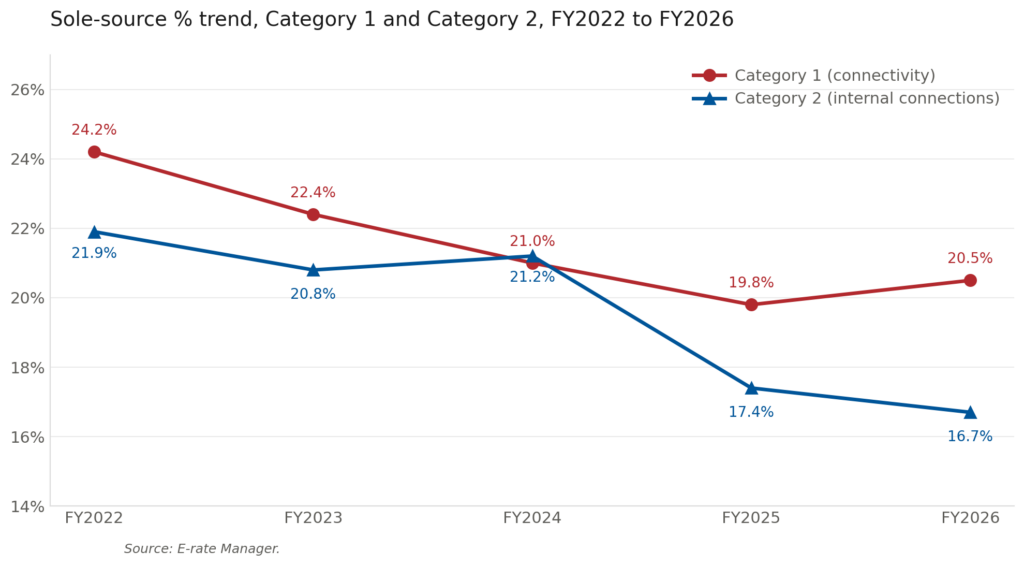
In FY2022, 24.2% of Category 1 funding requests received only one bid. By FY2026, that figure had fallen to 20.5% — a 3.7 percentage point decline. Category 2 saw a sharper improvement, with sole-source filings dropping from 21.9% to 16.7% over the same period.
Fewer applicants are finding themselves with only one option — precisely the outcome the competitive bidding rules were designed to produce.
The program delivers
Of the $3.00 billion requested in FY2022, $2.66 billion has been committed to applicants — an 88% commitment rate. FY2023 produced an 86% commitment rate, and FY2024 reached 82%. Funding years that have had time to fully process have consistently landed in the mid-to-high 80% range.
When applicants request funding, the program delivers.
What this means for reform
The FCC’s April 30, 2026 order announced a new competitive bidding portal beginning in funding year 2028, which will reshape the procedural infrastructure this analysis documents.
The numbers above represent the baseline any reform will inherit. The multi-year decline in sole-source filings. The steady rise in bids per FRN. The consistent commitment rate. These competitive gains should be central design criteria for any successor system.
Reform should be evaluated against a straightforward question: does it sustain or improve these outcomes for the applicants who actually use the program?
Make your voice heard
The applicants who file Form 470s and Form 471s every year are the most direct source of evidence on how the program performs in practice. Their procurement experience — accumulated across hundreds of thousands of funding requests and tens of thousands of competitive bidding events — is the empirical record any reform must answer to.
Funds For Learning’s Annual Applicant Survey collects that feedback. FCC policymakers, USAC, and the broader E-rate community use the results to inform program decisions. With reform of the bidding infrastructure now underway, this year’s survey carries particular weight.
If you want your procurement experience reflected in the regulatory record, please complete the 2026 Annual Applicant Survey. The survey closes at the end of July 2026.