
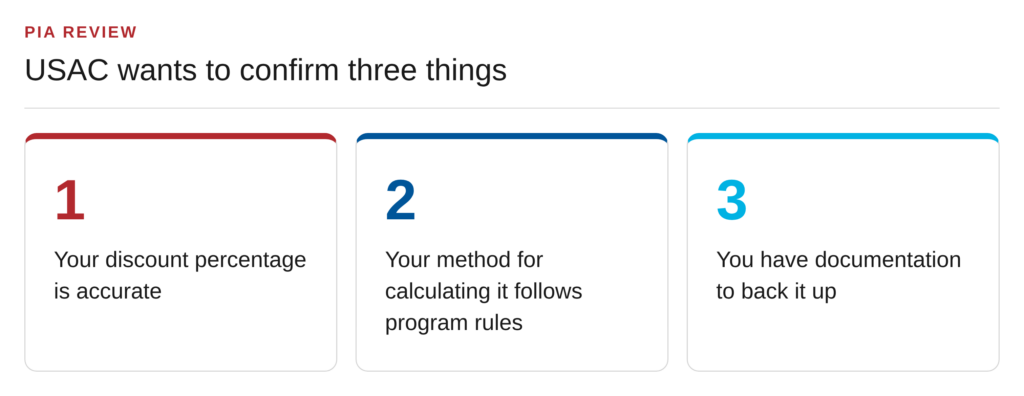
If USAC selects your application for Program Integrity Assurance (PIA) review, one of the first things they’ll ask about is your discount rate, and the documentation behind your National School Lunch Program (NSLP) numbers. Here’s what they want to see, and how to have it ready before they ask.
During review:
What Reviewers Are Really Looking For
When reviewers evaluate your NSLP data, they are not just looking for a number—they are looking for the story behind the number.
Every percentage you report must be supported by clear, traceable documentation.
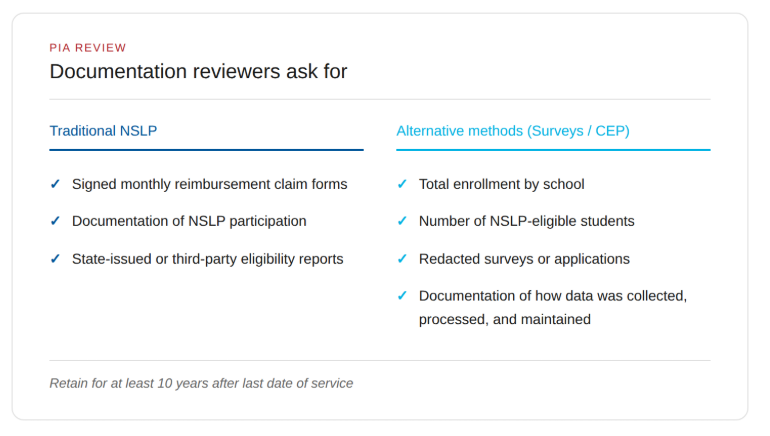
If your district relies on traditional NSLP participation data, you may be asked to provide:
- Signed monthly reimbursement claim forms submitted to the state
- Documentation demonstrating participation in the NSLP program
- State-issued or third-party reports confirming eligibility percentages
These documents are what proves your discount rate. Without them, you’re asking the reviewer to take your word for it.
Using Alternatives to NSLP (Surveys or CEP)
If your district uses an alternative method, such as household surveys or the Community Eligibility Provision (CEP), you should be prepared for more detailed follow-up questions. CEP applicants in particular should know that your base year can be reclassified during PIA review. USAC allows alternative discount mechanisms, but they must align with NSLP income guidelines and follow strict data collection rules.
Reviewers may request:
- Total enrollment by school
- Number of students eligible under NSLP guidelines
- Copies of surveys or applications used to determine eligibility (with personally identifiable information redacted)
- Documentation explaining how the data was collected, processed, and maintained
Beyond the documents themselves, applicants may need to confirm that:
- Only students meeting federal income eligibility guidelines were included
- Surveys were distributed to all students, not just a subset
- Results were not extrapolated, but based on actual responses
If your survey or CEP data doesn’t follow these rules, USAC may not accept the results — even if your numbers are accurate.
Documentation Is Everything
USAC expects applicants to retain all documentation that supports the Form 471, including NSLP eligibility data used to calculate discounts.
Best practices include:
- Retaining state-issued reports whenever possible (these provide third-party validation)
- Maintaining clear records of how eligibility was determined
- Keeping anonymized copies of surveys or applications used in calculations
- Saving all supporting documentation for at least 10 years after the last date of service.
Well-organized documentation doesn’t just support your current application. It protects you in the event of an audit or future review.
Common Pitfalls to Avoid
Based on typical PIA inquiries, several recurring issues can delay or jeopardize funding:
- Providing NSLP data that cannot be traced back to a source document
- Using data that was updated after the filing window closed
- Failing to clearly explain how discount percentages were calculated
- Not retaining underlying documentation, especially for survey-based methods
One more thing: once a filing window closes, your discount data is generally locked in. Changes made after that point can delay your review.
Tips for a Smooth PIA Review
- Be prepared early
Gather and organize your documentation before submitting your Form 471 so you’re ready when questions arise. - Respond clearly and directly
USAC reviewers are looking for specific answers. Stick to the question and provide exactly what is requested. - Respond promptly
Timely responses keep your application moving through the review process. - Tell the full story
If your discount calculation involves multiple methods or unique circumstances, explain them clearly and include supporting documentation.
In E-rate, getting to the right discount isn’t enough. You have to be able to prove it. That’s the kind of preparation our Guides talk through every month. Join us at our next My E-rate Guides (MEG) webinar on June 4 at 11 AM ET, covering what we’ve learned since the April 30 order, service substitutions that still trip up experienced applicants, and a CIPA refresh. Register for the June 4 MEG.
About the author: Heidi Leonard has been an E-rate Guide at Funds For Learning for nearly three years. Before joining the GuideTeam, she was a classroom teacher. She started as a substitute, then taught second grade, then eighth, which means she worked in the frontlines. Her advice to applicants is straightforward: “Document retention is critical in E-rate. It is what lets you prove compliance and eligibility when USAC comes asking.” Outside of work, Heidi is training for a 5K with her parents this June, and she gardens, cooks, and reads in roughly equal measure.