

The FCC’s latest round of E-rate appeal decisions, released September 1 (DA 26-868), reinforces three lessons that apply no matter what funding year you’re in: put your full case in your original appeal, make sure your Form 470 covers everything on your Form 471, and treat a canceled funding request as final.
What Was Decided
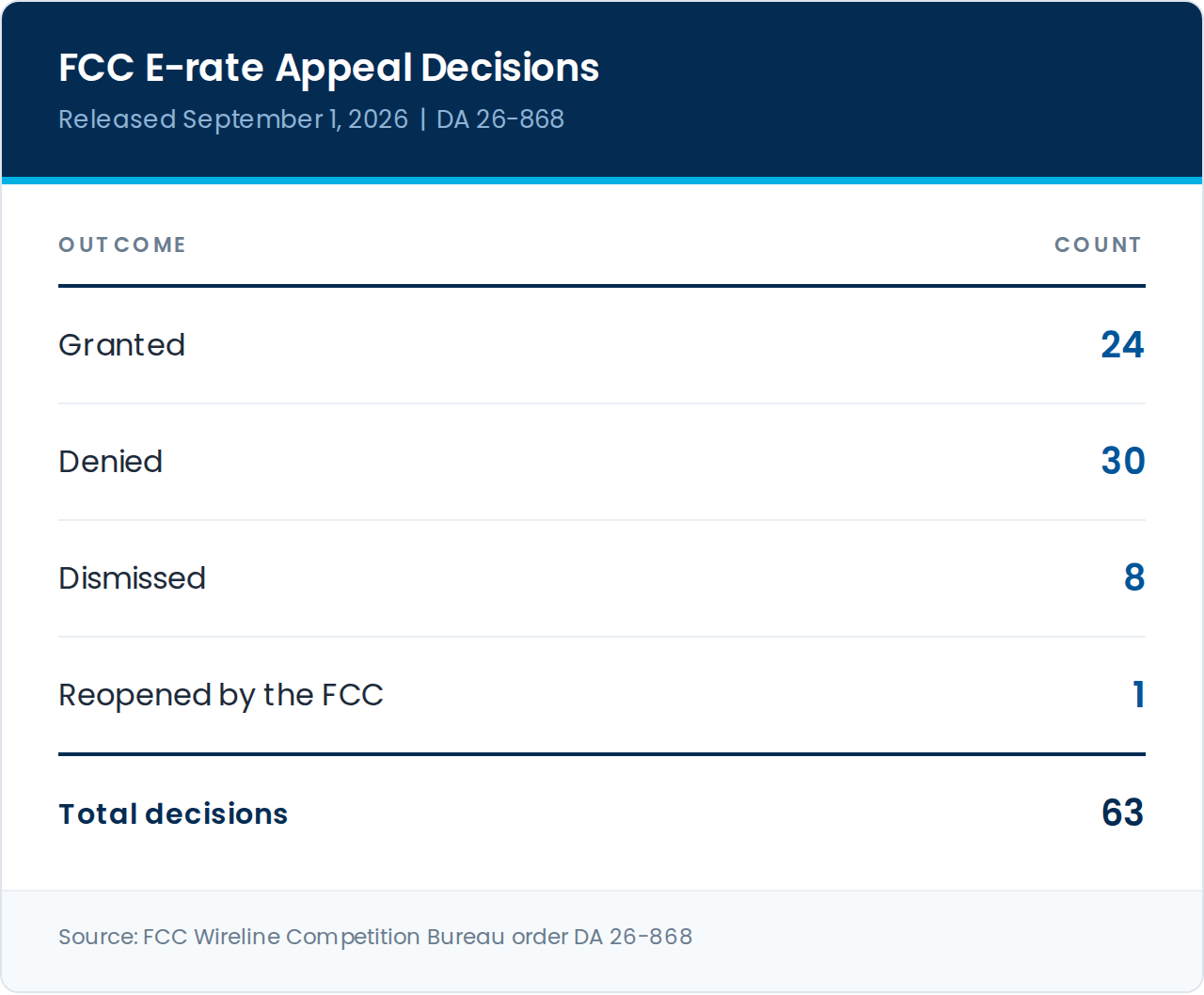
Grants covered timely filed Form 471 applications, eligible services, late-filed Form 471 applications due to circumstances beyond applicants’ control (filed within the 14-day window), ministerial and clerical errors, and special construction service delivery deadline waivers. Denials were led by late-filed Form 471 applications, untimely appeals, and two competitive bidding related denials.
The FCC’s Wireline Competition Bureau, the office that decides E-rate appeals, also reversed itself once this month: after taking a second look at a decision from last month’s order, it determined the applicant’s original appeal had actually been filed on time all along, so the earlier waiver and remand weren’t needed.
Lesson 1: Present Your Full Case in the Original Appeal
Two requests for reconsideration involving late-filed Form 471 applications were dismissed in part because the applicants added new detail on reconsideration that wasn’t part of their original waiver requests.
If the information was available but you just didn’t include it the first time, you can’t introduce it later.
This is one of the most important lessons in E-rate appeals: when you file a waiver request or appeal, put everything you’ve got into it the first time. Reconsideration isn’t a “do-over” for a filing that was incomplete the first time around.
Lesson 2: Your Form 470 Must Cover What Your Form 471 Requests
One denial this month involved an applicant that tried to add line items to a Form 471 for a service type and an entity that weren’t included on the original Form 470. The Bureau denied the request to add those line items and sent the application back to USAC to correct the existing funding commitment. The outcome wasn’t a total loss of funding, just a correction to what had already been approved.
The rule here is simple: your Form 470 has to accurately describe the services you’re seeking and the entities you’re serving, so every potential bidder has a fair shot at responding. If you request funding on your Form 471 for something your Form 470 never mentioned, that’s a problem.
Before you submit your Form 471, double-check that every service type and every entity you’re funding is clearly reflected in your original Form 470.
Lesson 3: A Purposefully Canceled Funding Request Can’t Be Reinstated
One request for reconsideration asked the Bureau to reinstate a funding request the applicant had previously canceled, and to waive the competitive bidding rules for it. The Bureau said no.
If you cancel a funding request on purpose, it can’t be reinstated. Treat that decision as final.
We Read These So You Don’t Have To
Reconsideration isn’t a do-over, and a Form 470 that doesn’t match your Form 471 can cost you line items. Not sure whether your own filings would hold up against these three lessons? Our Guides work through Form 470 scope and appeal deadlines with applicants every funding year, and most of these problems are far easier to prevent than to fix on appeal. Request a consultation today.
About the Author: Verlyne Jolley is a Director at Funds For Learning with more than 20 years of experience helping schools and libraries navigate the E-rate program. Her work focuses on regulatory compliance, program administration, and helping applicants understand and adapt to evolving FCC and USAC requirements.