
The E-rate community just spoke with one voice. Ninety-plus organizations, school districts from Los Angeles to Philadelphia, library associations, service providers, and consulting firms all signed the same letter opposing the FCC’s proposed bidding portal. That kind of alignment doesn’t happen on FCC dockets. The Commission votes Thursday, April 30, 2026.
Here’s what’s in the docket, what filers are asking for, and what applicants should watch this week.
A 90+ organization letter, a detailed seven-organization policy brief, ex parte filings from state agencies and large school districts, and filings from consulting firms have all landed in the docket since the draft Report and Order was released April 9, 2026. The letter alone is the broadest cross-stakeholder show of opposition this docket has seen. Major school districts (Los Angeles Unified, San Diego Unified, Palm Beach County, Philadelphia, Madera, Clovis), library and education associations (ALA, AASA, AFSA, NEA, NAIS, NCEA), state E-rate coordinators (SECA), service providers (Fatbeam, Zayo, HPE, UDT, Epic Communications), and consulting firms (CRW Consulting and E-Rate Central) all signed the same document. That kind of alignment across schools, providers, and consultants is unusual on any FCC docket. Notably absent: the major service-provider trade associations and the largest national carriers.
Funds For Learning has been tracking this issue closely. Our April 13, 2026 analysis flagged the same procurement, timeline, and cost concerns now appearing across the docket.
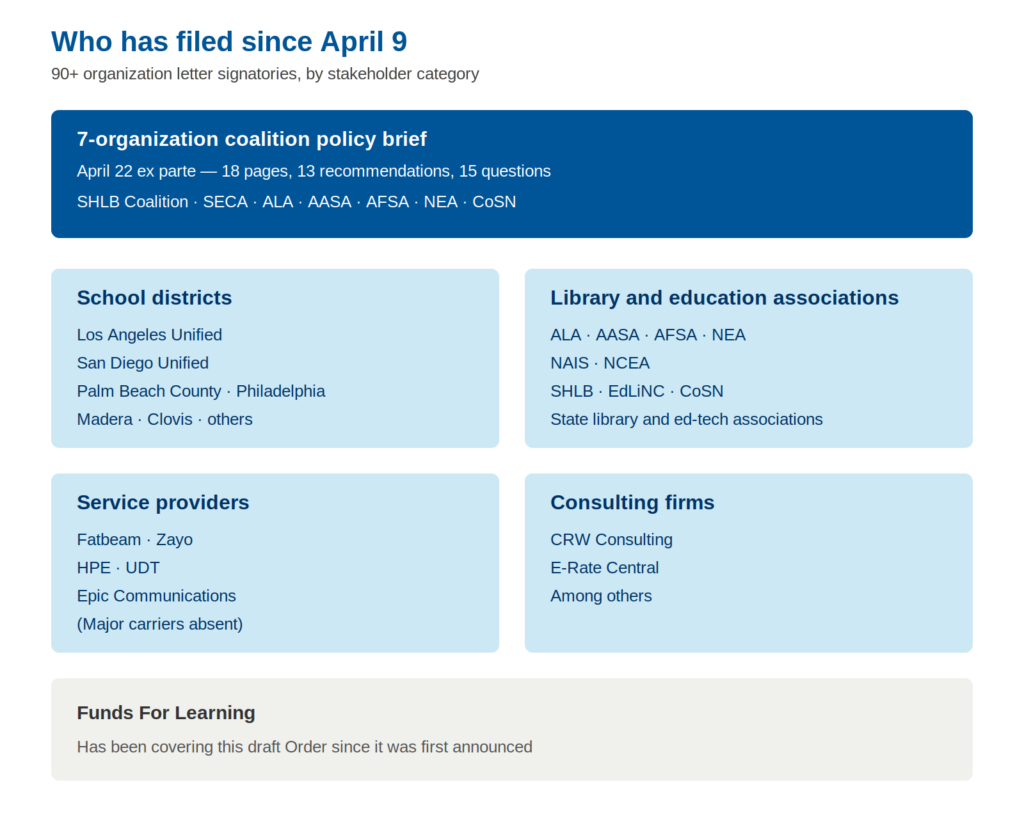
The coalition itself isn’t new. The portal concept first appeared in a 2021 FCC NPRM, and SHLB, SECA, and CoSN raised similar concerns in 2022. What’s different now is the scale of who’s standing with them.
Five arguments are showing up across nearly every filing
1. The program doesn’t have a fraud problem that warrants this. The December 2025 Government Accountability Office (GAO) report (GAO-26-107444) found E-rate is the only federal program GAO reviewed with documented procedures across all nine recommended fraud-prevention practices. Separately, the Funding Year 2024 E-rate improper payment rate dropped to 1.27%, below the 1.5% statutory threshold. Filers point to both as evidence that the case for the portal has weakened, not strengthened.
2. It creates real legal conflicts for applicants in many states. The portal would conflict with state and local procurement law in concrete, specific ways. Los Angeles Unified cites California provisions on bidder’s security, public bid opening, and newspaper advertising that the portal’s structure would prevent compliance with. Under California Education Code § 17606, school district officials can be personally liable for payments under contracts that violate state competitive bidding law. Without explicit federal preemption, LAUSD argues California districts can’t safely use the portal at all. The seven-organization filing references similar conflicts raised by agencies in at least 12 states.
3. The timeline isn’t workable. Every major filing asks the FCC to push the effective date from Funding Year 2028 to Funding Year 2029. Filers cite the troubled 2016 EPC rollout (extended filing deadlines, blanket waivers, design flaws that consortium applicants still live with) as a cautionary tale. The seven-organization filing specifies what would be needed: 60-day public comment on business requirements, 60-day beta testing, a one-year grace period for first-year procedural errors, and FAQs.
4. There’s a better alternative already on the table. Rather than a portal that replaces the entire competitive bidding process in real time, filers propose a simpler system where applicants and providers upload bid responses, evaluations, and final contracts after the bidding process closes. This was originally recommended by the FCC’s own Office of Inspector General. SHLB and the seven-organization coalition develop it in detail.
5. No one has priced this out. Costs are unquantified. Multiple filings note the draft Order doesn’t estimate the portal’s development or operating cost, doesn’t compare cost to benefit, and doesn’t address the impact on the Universal Service Fund contribution factor, despite the cost being borne by USF contributions.
What filers are asking for
Pull the portal as proposed. If the FCC moves forward, replace it with a bid repository and delay implementation to Funding Year 2029, with stakeholder input on business requirements, beta testing, and a grace period.
What to watch
The Commission votes Thursday, April 30. The docket is now closed. Under the FCC’s sunshine rule, ex parte filings on agenda items stop when the meeting agenda is published, so what’s described above is essentially the full record the Commission will weigh on Thursday. Whatever the outcome, the implementation details and the Funding Year 2028 timeline are likely to be the next battleground. If the portal moves forward, the concerns now in the docket (state and local procurement conflicts, administrative burden, vendor participation, reduced flexibility) will need to be resolved before this system goes live.
We’ll be monitoring Thursday’s meeting and will report on the outcome.
Tracking every docket entry on the bidding portal isn’t your job. It’s ours.
Request a free E-rate consultation and we’ll walk through what this means for your filings.