

The FCC has released, for the first time, a comprehensive public dataset covering funding requests and initial commitments under the Schools and Libraries Cybersecurity Pilot Program. The data provides the clearest picture yet of how the $200 million pilot is unfolding, including nationwide participation, applicant priorities, and the first wave of funding commitments issued in December.
While the program is still early in its lifecycle, this initial release offers important insight into how schools and libraries are approaching cybersecurity investments, and how the pilot may inform future policy decisions.
Key Takeaways: Cybersecurity Pilot Data Snapshot
- The full dataset is now public. The FCC released Cybersecurity Pilot funding request and commitment data for the first time, covering nearly 90% of selected participants and $157.6 million in requested funding across all 50 states.
- First funding commitments are underway. On December 17, 2025, the FCC issued the first Cybersecurity Pilot FCDLs, committing $18.8 million to 140 applicants.
- Demand is concentrated. Texas and California alone account for 36% of all requested funding, and urban districts request significantly more funding than rural applicants.
- Managed detection and response leads. Monitoring, detection, and response services represent more than 40% of all requested dollars, signaling a shift toward ongoing, service-based cybersecurity models.
- More funding decisions are coming. With substantial budget remaining and many applications still under review, additional commitment waves are expected.
What this data represents
This dataset reflects the universe of Cybersecurity Pilot Form 471 applications, including:
- Certified funding requests submitted by pilot participants
- Funding Commitment Decision Letters (FCDLs) issued to date
- Both pending and committed FRNs
The Form 471 filing window for the Cybersecurity Pilot closed on September 15, 2025, and Program Integrity Assurance (PIA) review is ongoing. As with E-rate, funding commitments are expected to be issued in multiple waves as review progresses.
The big picture
Across the full dataset:
- $200 million total pilot budget
- 690 participants selected in January 2025
- 614 participants filed Form 471s (an 89% participation rate)
- $157.6 million requested, representing 79% of the pilot budget
- All 50 states represented, making this a truly national pilot
The high participation rate suggests strong engagement among selected participants and provides a broad base of data for evaluating cybersecurity needs across different geographies and district sizes.
First wave of funding commitments
On December 17, 2025, the FCC issued the first wave of Cybersecurity Pilot commitments:
- $18.8 million committed
- 140 applicants funded (23% of applicants)
- 222 FRNs funded (16% of FRNs)
- 9.4% of the total pilot budget committed
- Average commitment per applicant: approximately $134,000
Thirty states received funding in this initial wave. Illinois led with 26 funded applicants ($2.07 million), followed by Texas with 16 applicants ($1.62 million).
What applicants are buying
Across all funding requests, service categories break down as follows:
- Monitoring, Detection & Response: $68.6M (43.5%)
- Identity Protection & Authentication: $40.3M (25.6%)
- Endpoint Protection: $28.8M (18.3%)
- Advanced / Next-Generation Firewalls: $19.8M (12.6%)
The dominance of monitoring and response services suggests that applicants are prioritizing operational cybersecurity capacity, not just perimeter defenses.
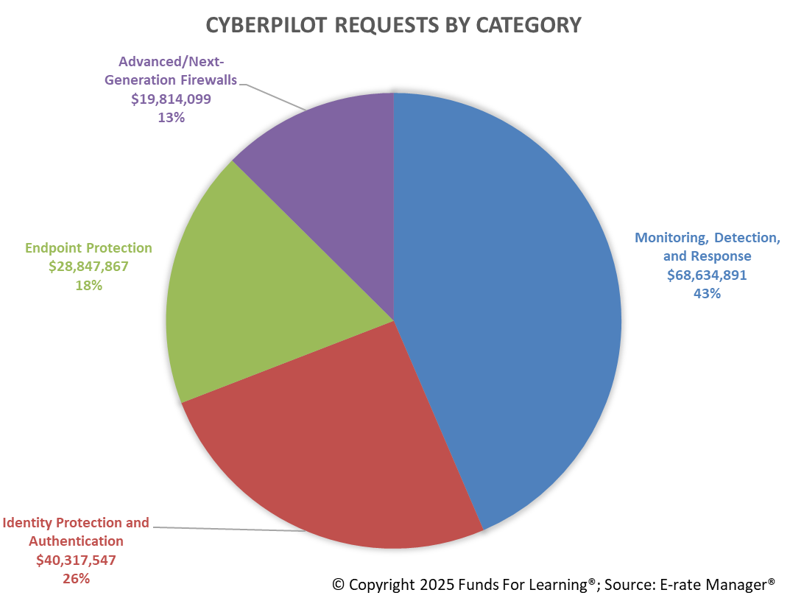
What applicants are buying
Geographic distribution: nationwide, but concentrated
While all 50 states are represented, funding requests are concentrated in a handful of large states:
- Texas: $31.4M (20% of all requested funding)
- California: $24.9M (16%)
- New York: $9.4M (6%)
- Illinois: $7.3M (5%)
- Ohio: $6.3M (4%)
One notable outlier is Hawaii, where a single statewide applicant (the Hawaii Department of Education) requested $4.8 million to cover the entire public school system.
Who is getting funded first
The largest commitments in the first funding wave include:
- Mobile County School District (AL): $1.6M — managed detection and response
- Jefferson County School District (AL): $850K — managed threat detection
- Rockford School District 205 (IL): $828K — cloud-based analytics and monitoring
- Lubbock ISD (TX): $739K — managed detection and response
- Fontana Unified School District (CA): $624K — firewall and identity solutions
These early commitments reflect a strong emphasis on ongoing monitoring and response services, rather than one-time hardware deployments.
Urban–rural disparities persist
Despite nationwide participation, funding requests remain uneven:
- Urban applicants:
- 74% of applicants
- 90% of requested funding
- Average request: ~$314,000
- Rural applicants:
- 26% of applicants
- 10% of requested funding
- Average request: ~$96,000
These gaps may reflect differences in staffing, procurement capacity, or access to cybersecurity expertise — issues the pilot may help illuminate.
Applicant size matters
Larger districts account for a disproportionate share of funding:
- 50,000+ students: 19 applicants, 25% of funding
- 10,000–50,000 students: 120 applicants, 45% of funding
- Under 2,500 students: 286 applicants, only 9% of funding
As a result, much of the pilot’s data will reflect mid-to-large district environments, which may shape how lessons are interpreted for smaller applicants.
Looking ahead
With approximately $181 million still available and $139 million in pending requests, the FCC has substantial room to issue additional funding waves. As PIA review continues, future FCDLs will further clarify how different service models, procurement approaches, and applicant types fare under the pilot.
Funds For Learning will continue tracking Cybersecurity Pilot funding data and providing analysis to help schools, libraries, service providers, and policymakers understand what the numbers reveal — and where important questions remain.