

Applicants often focus on reaching the Allowable Contract Date (ACD), the earliest date you’re allowed to sign a contract after posting your Form 470, but compliance depends on more than simply waiting 28 days.
Changes made during the bidding process can affect the validity of that original 28-day waiting period. And Program Integrity Assurance (PIA) reviewers often examine your entire procurement timeline, not just the date on your contract signature.
Biggest Gotcha: Cardinal Changes
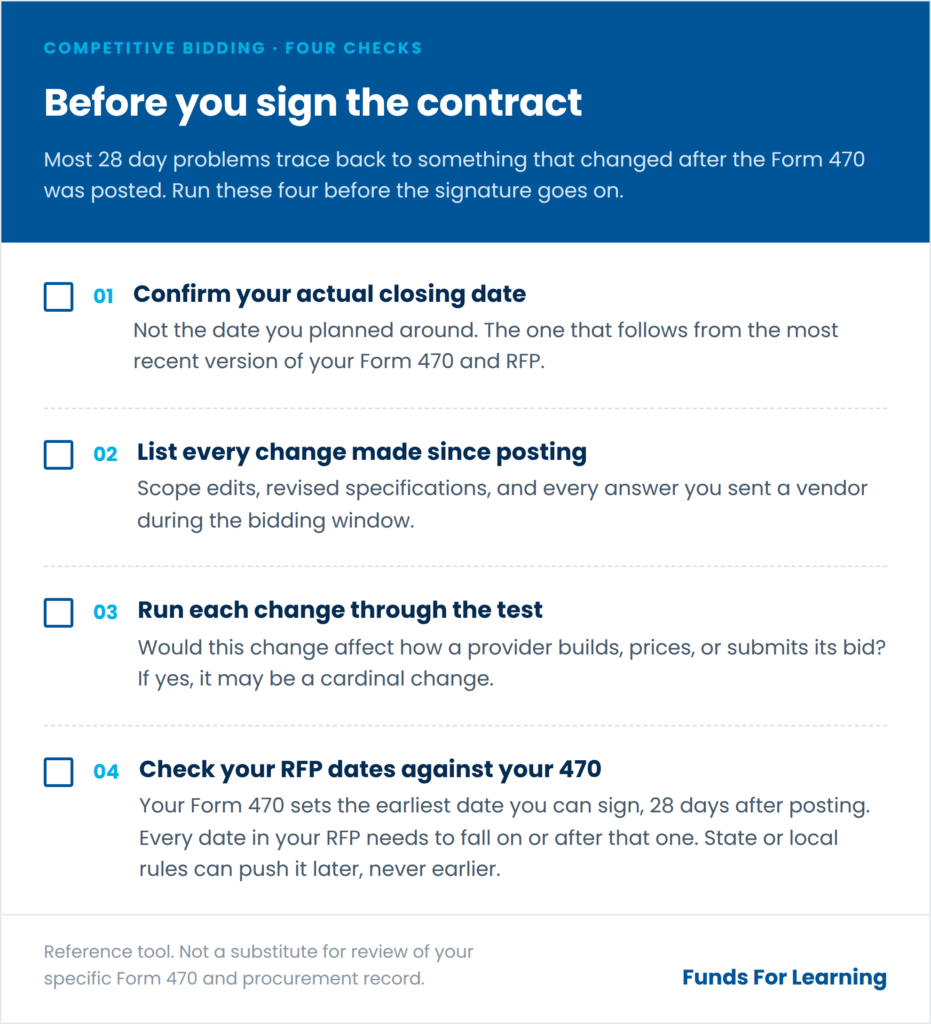
A cardinal change is any change to the scope of your Form 470 or associated RFP significant enough that it could have affected how a vendor built, priced, or submitted its bid, had they known about it from the start.
Here’s the test to ask yourself: Would this change affect how a provider builds, prices, or submits its bid? If yes, it may be a cardinal change.
Cardinal changes require restarting the competitive bidding process and a new 28-day waiting period. Applicants frequently overlook this requirement, often because the change felt minor at the time.
How Cardinal Changes Happen
Cardinal changes often occur unintentionally. One of the most common ways this happens is when applicants respond to vendor questions during the bidding process. A response you intend as a simple clarification can accidentally change the scope of your request without you realizing it.
Under USAC’s fair and open bidding requirements, any information shared with one vendor that could affect how it prepares its bid must be made available to all vendors who received the solicitation. An informal or one-off answer that isn’t distributed in this way can inadvertently alter the scope or terms of the original request; turning a routine clarification into the kind of change that may require a new bidding cycle.
Cardinal Change Examples
- Increasing bandwidth requirements (for example, requesting 1 Gbps and later deciding 10 Gbps is needed)
- Adding installation services that were not originally requested
- Changing licensing or contract terms (for example, requesting multi-year licenses and later deciding on a one-year term)
- Adding services, locations, quantities, or requirements not included in the original posting
- Making substantive changes to an associated RFP that alters the scope of work
RFP Timing and ACD Compliance
One common mistake is adding an RFP to your Form 470 without reviewing the dates carefully. If your RFP references an ACD, bid deadline, award date, or contract date, those dates need to align with your competitive bidding timeline. The ACD shown in your procurement documents can’t be earlier than your required waiting period.
Keep in mind that state or local procurement requirements may require a bidding window longer than 28 days. Verify that your Form 470 dates and your RFP dates stay consistent throughout the entire procurement process.
Practical Takeaway
Most 28-day issues trace back to changes made after the Form 470 is posted, such as an updated scope, a revised specification, or a clarifying answer that goes further than intended. Any of these can constitute a cardinal change, which resets the 28-day clock and moves your closing date.
Keep track of your Form 470/RFP closing date throughout the bidding period and revisit it any time the project scope shifts.
Planning a multi-year procurement in FY2027 to get ahead of the new bidding portal? A cardinal change is even costlier in that scenario. See Procure in FY2027, Breathe Easier in FY2028.
Not sure if a recent change to your project counts as a cardinal change? Our Guides work through these situations all the time. Schedule a consultation today to see what it would look like to work with a GuideTeam.
About the Author: Elizabeth brings a unique perspective to her work at Funds For Learning; having been homeschooled herself, she has a deep appreciation for traditional school systems and the vital importance of educational resources. She thoroughly enjoys partnering with school and library contacts who juggle multiple responsibilities to stretch their budgets for their communities.